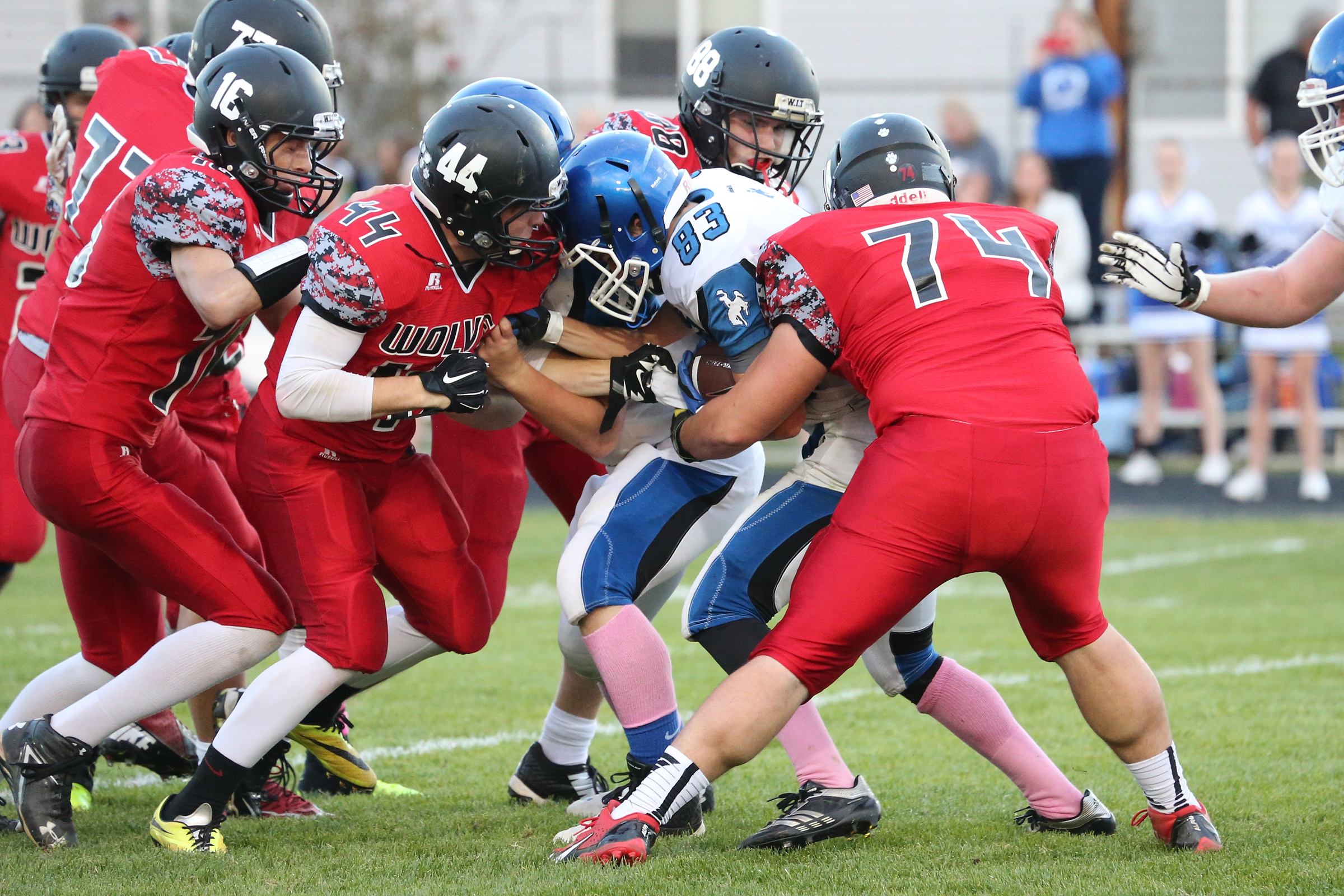
Will scenes like this one day be just old memories? (John Fisken photo)
“High school football will be gone in five years.”
Those words, said to me in the parking lot after Coupeville’s season-opening win over arch-rival South Whidbey Friday, came from someone not prone to hyperbole.
The speaker has an extensive football background, as a player, coach and administrator, and is pretty spot-on in their assessment of almost anything involving prep sports.
One part of me, the part which has camped out in many a press box and at the top of many a visitor’s grandstand over the years, is quick to dismiss that as a lot of hooey.
No high school sport captures the imagination quite like the myth built up around Friday Night Lights.
Every sport has its die-hard fans, but high school football is the great equalizer.
Take almost any school, and whether its football program is a powerhouse or an also-ran, the stands are stuffed. People ebb and flow around the track, on the grass, at the concession stand.
Some are there to watch the game. Others just to see and be seen.
It is a social setting unlike any other high school sport, one whose fan base cuts across all cliques. Everyone shows up, especially in a small town like Coupeville.
Which also means football is the single biggest money-generator for any high school, and it’s not even close.
From the crackle of excitement in the crowd as the sun sets and kickoff approaches to the swarms of people taking photos on the field after a game — parents, siblings, relatives, significant others, classmates — it’s a communal, time-honored tradition, and it’s hard to imagine it not existing.
But…
As I said, the person who uttered that statement has maybe been wrong twice in the last 25 years (and even that’s debatable), and cold, hard facts and figures paint a disturbing picture.
Participation in high school football is down.
Way down. Way, way, way down.
With the increased attention on concussions and other traumatic injuries (NFL players retiring in their 20’s or leaving their bodies to science, ESPN football commentators quitting their job in protest, etc.) something is happening.
High school football participation dropped by 25,901 students from the 2015 to the 2016 season.
And that’s even with an additional 61 schools having started, or revived a program last year.
That one-year drop almost equals the decline (28,000) seen between 2008-2015 nationally.
While the national numbers for 2017 aren’t out yet, it’s a pretty certain bet we’re looking at another huge dip.
Scan the rosters for the Olympic/Nisqually League, a mashup in its second year of play, and the drop-off is shocking.
In 2016, seven of eight teams counted 32 or more men on their roster, with only Chimacum failing to crack the 30-man barrier.
This year, six of eight teams DON’T currently reach the 30-man barrier.
Coupeville, with 28 players (down from 33 last year), has gone from the third-smallest roster to the third-biggest, despite losing bodies.
With the exception of Klahowya, which is essentially a 2A school which slips under the 1A cutoff by half a whisker, the league is shrinking away.
Here’s a roster comparison between 2016 and 2017, based on numbers pulled from MaxPreps:
| School | 2016 | 2017 |
| Bellevue Christian | 52 | 27 |
| Cascade Christian | 41 | 27 |
| Charles Wright | 40 | 34 |
| Chimacum | 26 | 27 |
| Coupeville | 33 | 28 |
| Klahowya | 69 | 55 |
| Port Townsend | 32 | 25 |
| Vashon Island | 35 | 28 |
Look at those numbers again. The league went from 328 to 250 players in one year. ONE YEAR.
It’s already had an impact, as Port Townsend forfeited its season opener against Sequim, citing “not enough eligible players.”
Coupeville, which, as we said, has the third-largest roster now, averaged 41.5 players from 2006-2015.
And, before you say, well, maybe the student body was bigger back then, no it wasn’t.
CHS is a small 1A school which came really close to returning to 2B not so long ago, so any thoughts of boasting a 50-man roster have rarely, if ever, existed, no matter the decade.
But a larger percentage of the school’s male population played football in the past, and that is true at EVERY school in our league.
While there might be a lot of mitigating circumstances (players choosing other sports, opting for academics over sports or being held sway by all their technological gadgets), it’s hard to ignore the increased attention on injuries.
While it’s not so much that football is any more dangerous today (with better equipment and training, the reverse is probably true), but that the focus on what could go wrong is front and center.
And you can’t fault parents and players if this is the route they’re choosing.
The ability to walk and talk as an adult matter far more than who won a rivalry game, no matter how much sports writers hyperventilate about on-field accomplishments.
Coupeville High School senior Jacob Zettle was injured last year while making a tackle in a game at Klahowya.
He remained prone on the turf for close to 15 minutes before medics transported him to a hospital, and the experience was a major factor in his decision not to play this season.
“I’ve had a good handful of concussions before this, and so when I got this one it took a couple months for me to decide not to play because I love the sport so much,” Zettle said. “But with a cervical sprain and strain, and major concussion, I thought better of it.
“Being taken off a football field, in an ambulance, on a backboard with a neck brace, is pretty scary,” he added. “That was a huge wake-up call.”
Zettle does stress that while he believes leaving the sport was the best choice for him, it’s a personal decision best left to each athlete and their family.
“I don’t discourage others from playing! In fact, I love seeing people play!,” he said. “But I do want to say be super careful, because one displacement of your head or anything else for that matter can be a career ender.”
While there is little doubt most modern coaches stress proper techniques, helmet makers are continually upgrading equipment, and health is on everyone’s minds, football will always be a violent game.
It is the very nature of the beast.
As someone who has been on the sidelines of the sport for years, I find it hard to believe it will ever go away.
But I’ve been wrong before — many, many times.
Maybe the numbers, locally and nation-wide, will level off, or even start going back up.
But, quicker than we might think, we may be having the same conversations in Washington state that they are in New Jersey, where three high schools (with student bodies more than four times that of Coupeville) suspended varsity football programs due to declining numbers.
Instead of asking, “Are you ready for some football?” on a future fall Friday night, will we be left to ponder “Are you ready for some lacrosse … or ultimate frisbee?”
The mind boggles.








































 Coupeville Sports
Thank you for saying this