
William Nelson rose to success while playing on multiple CHS tennis courts. (Photo by JohnsPhotos.net)
The mission is complete … for now.
Ken Stange recently wrapped an 18-year run as Coupeville High School tennis coach, leading the Wolves through two seasons most years.
As he marinates in his “retirement” down at Bailey’s Corner Store, he’s sharing memories, deep thoughts, and (maybe) clues to where the bodies are buried.
A nine-part odyssey inside the mind of the man, the myth, the always-entertaining net guru:
We played the final match at the CHS tennis facility, right next to the school, this spring.
When the current school building was constructed, it was built around the already existing tennis facility.
Maybe they didn’t fit a new tennis facility into the bond that paid for the new school and gym remodel.
I loved that our courts were a prominent feature of the main school building. It was a great venue for a match, with some good viewing spots.
High school tennis matches don’t usually draw a large crowd, but there were a few years when our top singles player or doubles team were state medal contenders and, in those years, we drew large crowds for our matches.
Anyhow, I don’t know what to think about the district finally building a new tennis facility for what would have been my nineteenth year, had I stayed on as coach.
I do know that when it opens, I will certainly be one of the first people to play on the new courts.
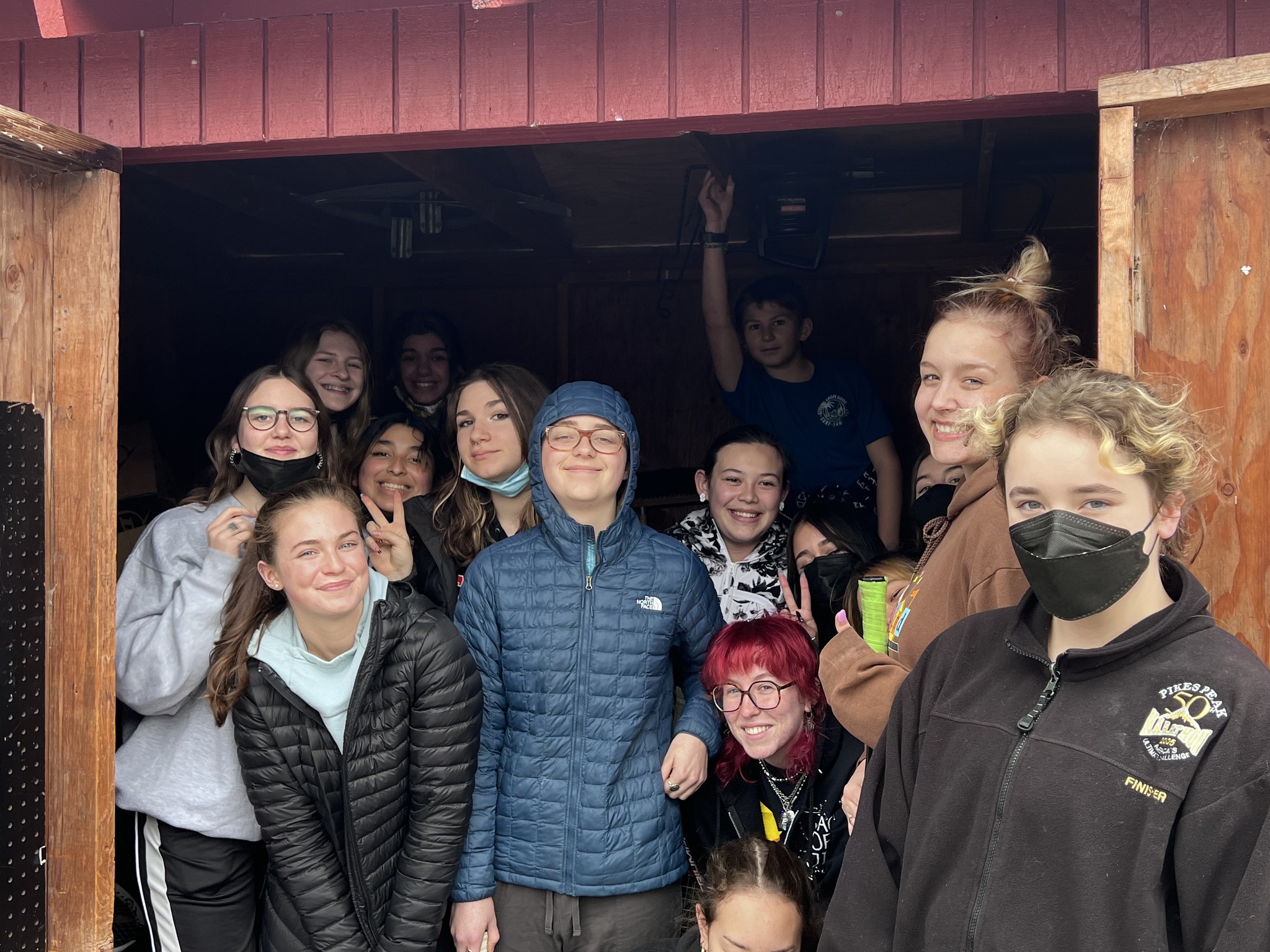
“Put us in, coach!” Coupeville tennis players avoid the weather by hanging out in a courtside shed. (Photo courtesy Ken Stange)
Those four courts hold many of my tennis memories.
Most are related to the players I coached, but many are related to my own tennis escapades, apart from the team.
If those courts could talk, here is what I think they’d say about my time there.
Court 4 would have some wild memories.
Despite being the least accessible, least popular, and most dangerous court to play on, it would say that the ride was good.
It would tell you how McKenzie Bailey and Jazmine Franklin owned that court for two years, putting up a 28-4 regular season record in the second doubles spot.
It would tell you how it bore witness to and helped shape the rise of Joey Lippo and William Nelson, #2 doubles duo who dethroned their #1 doubles teammates at the district tournament during their junior year.
It would tell you that even though it was always the last court chosen when recreational players showed up, it was always the home for a #2 doubles match, and that a team without a solid #2 doubles team won’t win many matches.
Being the court with a complex about being the least popular, it would be the first of the courts to tell you that it saw its fair share of wild #3 doubles matches.
Even though the other three courts could say the same thing because #3 doubles was the fifth match and never had a pre-assigned court.
It would tell you about how some of the greats from that time began their high school tennis careers at #3 doubles, and that those contests were usually the deciding matches.
It would tell you about how it had a special ability to bring out the most fun in players, maybe because it was the furthest away.
It would tell you that I fought for a giant depression behind the baseline to be fixed, and how after repeated requests and no action, it told me to send a formal maintenance request that included the words “insurance liability” in the description.
It would say, “See, Ken. You didn’t like me, and you rarely played on me, but look at those memories. You loved me all along!”
It would most certainly be correct.
Court 2 would share its own set of memories.
It would say that of all the courts, it was home to both some of the most exciting moments as well as some of the dullest moments in CHS tennis history.
It would tell you that it was the most uniquely positioned of the four courts, with the school building running behind the baseline and then about three fourths of the way up to the net.
It would boast of its asymmetrical background.
It would tell you how Chase Bates was the first player to figure out how to use the strange wind current as an advantage.
How he discovered a way to hit a ball that looked like it was going wide, only to be pushed back into the court by the wind that whipped along the interior corner of the building.
It would tell you how it was home to some of the most exciting #2 singles matches throughout the years, and how many of the singles players that occupied it used it as a steppingstone to the #1 singles court.
It would repeatedly tell you about the time Ben Hayes played a district match, in front of nearly 100 classmates who cheered him on, turning a typically quiet tennis match into something raucous.
Something more like a nighttime match at the US Open.
It would tell you about the time that Micky LeVine hit me in the windpipe with a wicked forehand, and how I couldn’t breathe for a minute.
It would tell you how all the players had looks of horror on their faces, except for Haleigh Deasy, who was uncontrollably laughing.

Wolf netters (l to r) Micky LeVine, Jacki Ginnings, Wynter Thorne, and Haleigh Deasy were part of an entertaining crew. (Photo by JohnsPhotos.net)
It would tell you about the dull stuff, too … the #2 singles matches that were played at such a slow pace that they were often compared to watching paint dry on growing grass.
However, it would also tell you that many of those matches were carefully played and won, and that those individual wins contributed to team wins.
It would tell you that I played my own tennis on that court and that I absolutely loved the asymmetry, extra shadows, and uniqueness.
It would tell you about some hard-fought matches filled with ups, downs, and passion.
It would tell you about how it was the court I played my first competitive tennis after breaking my back, and how I cried, both from the pain of recovery and from the overwhelming emotions that came with knowing that I was able to play again.
It would admit that Court 1 was where I relearned how to hit every single tennis shot because I’d lost so much range of motion.
It would tell you that Avalon Renninger and Tia Wurzrainer were there, hitting the balls to me, as I slowly rehabbed while on court.
It would tell you about how patient and kind they were to me that year … how they completely took the reins for me when I was barely able to walk.
It would tell you how even though I spoke highly of it, I was truly in love with Court 1.
TOMORROW: Court 1 and the final goodbye.





































 Coupeville Sports
Leave a comment