Feeds:
Posts
Comments

Posts Tagged ‘Bob Rea’

Bob Rea, the strikeout king of Snakelum Point. (Photo courtesy Rea)

Records are set to be broken.

You only have to look as far as the big board for track and field which sits just inside the entrance of the Coupeville High School gym.

Over the years, all-time greats such as Jon Chittim, Makana Stone, and Virgil Roehl set marks which seemed untouchable.

And yet, over time, most of those accomplishments have been surpassed, a testament to hard work, changes in training, and maybe all those hormones in the milk.

Yes, a few marks have endured decades — there are still records from the ’80s up there — and it’s the same in every sport.

Will anyone ever touch Ian Barron’s nearly-untouchable rushing records on the CHS football board?

Unlikely, but hey, once upon a time, we thought no one would reach Chad Gale’s receiving marks, and yet Hunter Smith eventually did.

It’s the same with volleyball records set by big-timers like Hailey Hammer and Mindy Horr and others.

They seem untouchable … until they aren’t.

There are at least three CHS records, though, which have endured for at least five decades, which would seem to make them truly untouchable.

However, I would argue that only one mark from that trio is truly safe.

The first two come from basketball, where Jeff Stone torched the nets for the single-game (48 points) and single-season (644) scoring records in 1970.

Working without the three-point line, the Wolf senior led Coupeville to the state tourney for the first time in school history, one hard-earned bucket at a time.

Over the past 50 years, no one has come even remotely close to the season mark, with the second-best individual season belonging to Jeff Rhubottom in 1977-1978.

And he scored 459 points, almost 200(!) points shy of what Stone threw down.

But, I would argue, neither record is truly safe.

With the three-point explosion in full bloom, the single-game record is begging to be topped, and even the season mark (while much safer) isn’t untouchable.

Hawthorne Wolfe had back-to-back games of 34 and 33 points this winter as a sophomore, and he’s only going to get stronger, quicker, and more confident.

Paired with the explosive Xavier Murdy, who also has two seasons left, the duo are primed to go on a scoring bender.

Will they make history? We’ll see.

Wolf legends from Mike Bagby to Pete Petrov to Randy Keefe to current CHS coach Brad Sherman all made runs at Stone’s marks, but couldn’t get there.

But it’s not out of the realm of possibility.

Which brings us to the one record I will stand behind as truly untouchable.

In the spring of 1964, Bob Rea, then a CHS junior, rang up 27 strikeouts across 16 innings in a 2-1 win at Darrington.

Look at those numbers for a second, remember that the opposing pitcher, Brian Mount, also tossed 16 innings, and then go look at the modern-day pitch-count rules which govern Washington state baseball.

It’s the record which will never, ever, ever, fall.

The game was played on a dusty field made up entirely of sand and gravel.

Train tracks slashed through left field, and any ball hitting said tracks was “fair game … you got as many bases as you could touch.”

“I can still see Ray Harvey, our left fielder, looking both ways before he stepped out on the tracks to recover a well-hit ball,” Rea remembered during a 2016 interview.

With an arm made strong by hucking rocks at Snakelum Point, Rea never thought about coming out of the game that day. That’s how you played in 1964.

He would keep on throwing through four seasons of college ball, after missing his senior season at CHS with a broken leg.

Rea was also a top-flight quarterback and one of the more-proficient scorers in Wolf basketball history, but his time on the baseball diamond is what will live the longest in Coupeville lore.

So why do I think his record is the one CHS mark which is truly untouchable?

Because a modern-day pitcher would have to be nearly flawless, while getting no run support, to make a run at Rea’s mark.

High school games in Washington state are seven inning affairs, so even if a hurler struck out every single hitter he faced, he’d still need at least two extra innings to reach 27 K’s.

To break the record, that 28th whiff would come no earlier than the 10th inning (our third extra frame), and, long before then, our pitcher would run into the biggest roadblock.

In 1964, you could pitch until your arm fell off, if your coach let you. Then you could duct-tape your arm back on, and keep on flingin’ heat.

In 2020, WIAA guidelines limit hurlers to no more than 105 pitches in a single day.

Go one over that, and the offending coach is imprisoned for 20 to life in the gulag. Or something close.

With three strikes to a hitter, you’d need 84 strikes minimum to get to that 28th K, while getting a strike on at least 80% of your allotted pitches, and heaven forbid if you needed a 106th pitch to break the record.

All while your team didn’t score a single run.

And that’s the bare minimum needed.

Toss in any walks or hits or errors, and your pitcher’s margin of error to reach 28 K’s becomes about .0000000000009.

So, we go back to the basketball court, where a three-point marksman could get hot (really hot) and catch Stone’s 48-point night.

I’ve personally witnessed a Coupeville player hit as many as 10 three-balls in a JV game, and eight in a varsity tilt, so while 17 treys in a night isn’t likely, it’s not out of the realm of possibility.

But 28 strikeouts in one game under modern-day rules?

Never gonna happen. Like never, ever, ever.
Read Full Post »

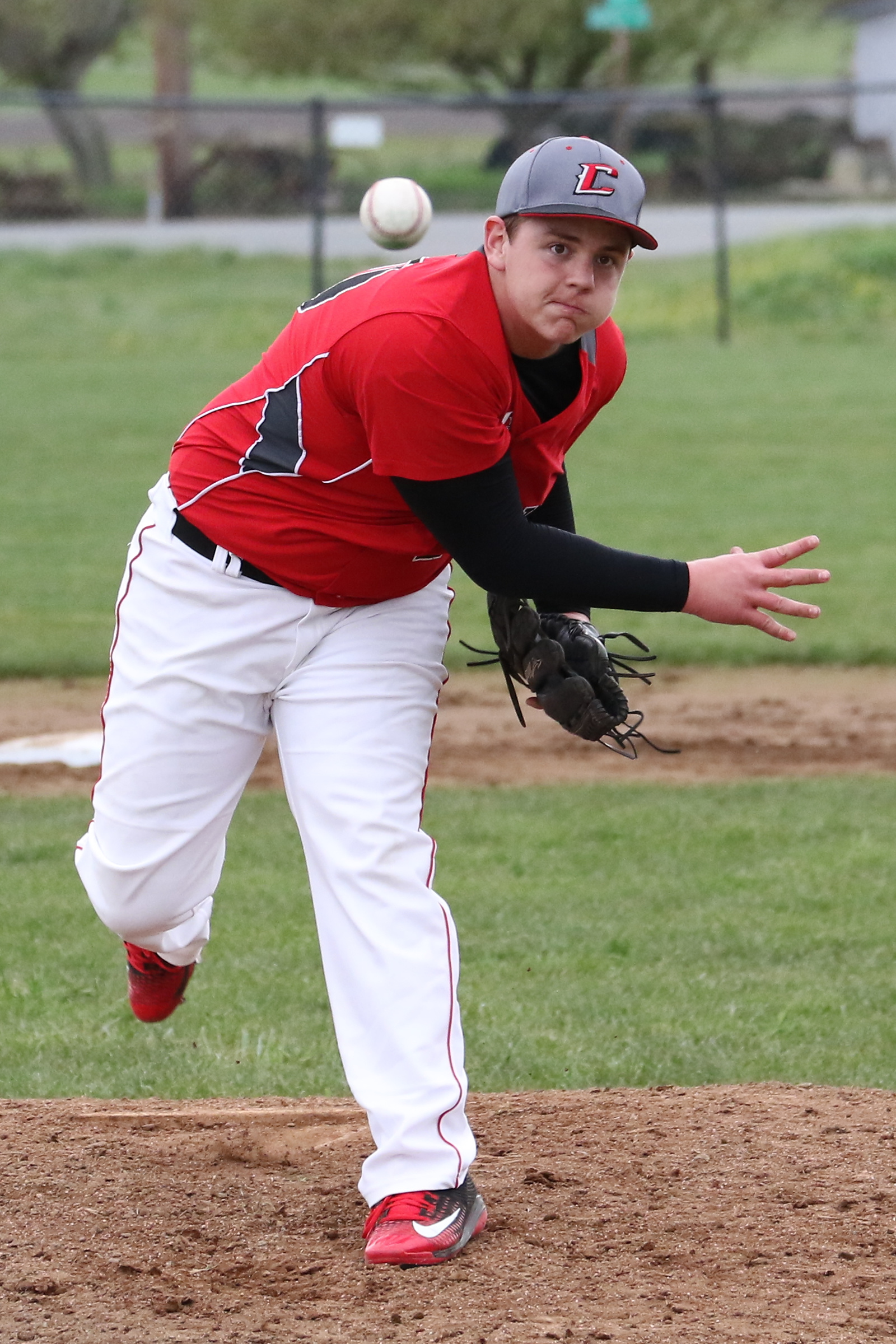
Julian Welling and his fellow CHS hurlers will be working under a pitch count this spring. (John Fisken photo)

   Julian Welling and his fellow CHS hurlers will be working under a pitch count this spring. (John Fisken photo)

When you talk about what are arguably the two greatest pitching performances in Coupeville High School history, one fact is crystal clear today — no one is matching them in 2017.

I’m talking about Bob Rea going 16 innings and whiffing 27 Darrington batters in a 2-1 win and Ray Cook taking down 21 sluggers in a 13-inning playoff game in ’76.

And why could they not be duplicated this season?

It has nothing to do with the talent of current Wolf hurlers like Hunter Smith or Julian Welling, and all to do with a brand-new rule instituted by the Washington Interscholastic Activities Association.

Effective immediately, no high school baseball pitcher in our state will be allowed to throw more than 105 pitches in a calendar day.

And, if they do hit that limit, or come within 29 pitches of it, they can’t pitch for the next three calendar days.

Seriously.

The days of making a run behind a true ace are gone.

Better to have a deep staff of halfway decent pitchers than one fireball-blazing stud in the “touchy-feely, can-I-encase-that-arm-in-bubble-wrap” age we’re entering.

Warm-ups pitches don’t count, but anything in the flow of the game does.

Score-book keepers will be expected to track pitch counts, with the home book the official final word, and both teams are supposed to confer after every inning to check the counts.

Umpires have no control over pitch counts.

And yes, a pitcher would have to leave in the middle of facing a hitter if he tops out.

Cue every batter in the world trying to perfect the 20-pitch at-bat, nicking foul ball after foul ball.

Violate the pitch count limits and get caught? You’re going to be smacked the same as if you got caught using an ineligible player.

Forfeit city, baby.

The limits:

76-105 pitches = 3 rest days
51-75 pitches = 2 rest days
31-50 pitches = 1 rest day
1-30 pitches = 0 rest days

So, if Smith throws 76 pitches on Mar. 15 against Chimacum, CHS can’t use him on the mound in its next two games — Mar. 17 vs. Sequim or Mar. 18 vs. South Whidbey — because he’s not eligible to pitch again until Mar. 19.


He could play in the infield, but step near the mound and the WIAA enforcement police will take him down with a dart gun.

Allegedly.

Read Full Post »

Dale Sherman, still basking in the glow of Coupeville's 1963 beat-down of La Conner on the gridiron. (Sherry Roberts photo)

   Dale Sherman, still basking in the glow of Coupeville’s 57-7 beat-down of La Conner in 1963. (Sherry Roberts photo)

Play like it’s 1963.

As the Coupeville High School football team heads to La Conner tonight (7 PM kickoff) to meet one of its most storied rivals, the stakes are relatively high for this early in the season.

While it’s a non-conference game, win and the Wolves open at 2-0 for the first time since 2009.

Plus, anytime you take down the Braves, who have a truly rich athletic history, it’s a cause for major celebration.

Which takes us back to Sept. 27, 1963 and the beat-down heard across the state.

That day a scrappy Coupeville squad found itself in a hole just one play into the game.

La Conner, having won the coin flip, took the opening kick-off to the house, returning it 80+ yards for a touchdown.

With barely a few seconds ticked off on the game clock, the Wolves were trailing, they were disorientated and they were desperate.

Or were they?

53 years down the road, the exact mood of the moment is probably hard to remember.

But this much is true, it shifted quickly.

Coupeville promptly threw down 57 unanswered points — eight touchdowns and a game-capping safety — and thrashed the bejeebers out of the Braves 57-7.

By the time they were done the Wolves would rack up a 386-23 advantage in yards, one of the most lopsided statistical games in CHS history.

Bob Rea, the strikeout king on the baseball diamond, got things going when he chucked a 46-yard bomb to receiver Denny Clark for a game-tying touchdown.

After that, it was boom, boom, boom, as the scores kept coming, one after another.

Rea connected with Clark for a second score, then the Wolves went to the ground with a relentless attack.

Denny Keith and Eddie Brown each rumbled into the end zone twice, while Dale Sherman and Gary Crandall both chipped in with their own stroll to pay dirt.

Crandall’s was a bit of a surprise, as he wasn’t even a running back.

With the score getting lopsided, Coupeville’s coaching staff moved Crandall, normally a lineman, into the backfield to give him a reward for his hard work.

Given the chance to inherit a skills position, he promptly rose to the occasion, shedding tacklers as he surged right up the middle to the promised land.

Not finished there, Crandall capped the scoring when, back at his normal position, he plastered a La Conner ball-carrier, riding him down in the end zone for a safety that brought a merciful end to the scoring onslaught.

The game remains one of the true high points in Coupeville football history, not only for the score, but for the level of the opponent toppled, as well.

It was truly a perfect storm.

And, it could and should be inspiration for the 2016 Wolves.

Go out there tonight and play like the ’63ers and 50+ years from now someone (maybe even me) will be telling your tale of triumph.

Read Full Post »

Hall

   The 1998 CHS volleyball squad is joined by (bottom, l to r) Dr. Jim Copenhaver, Bob Rea and Brian Fakkema.

High achievers, one and all.

Whether it’s sports, academics or life in the outside world, those who form the 50th class inducted into the Coupeville Sports Hall o’ Fame have had a huge impact, in town and far away.

So today we want to welcome two superb Wolf athletes whose prep careers were separated by 35 years, a contributor who helped spark a soccer revolution in Central Whidbey and one of the most brilliant teams to ever wear the red and black.

Say hello to Bob Rea, Brian Fakkema, Dr. Jim Copenhaver and the 1998 CHS volleyball squad.

After this, you will find them at the top of the blog, with their brethren under the Legends tab.

Our first inductee is Rea, the one true Strikeout King.

A three-sport star during his time at CHS in the mid-’60s, the pride of Snakelum Point was a star football and basketball player.

But it was on the diamond where his impact has lingered the longest.

Rea tossed a no-hitter against Tolt, but it was his ability to send batters down swinging which sets him apart 50 years after he last wore Coupeville’s uniform.

A lefty with a nasty curve, he made his name in 1964 on a dusty field in Darrington. Throwing 16 innings (or nine more than a normal high school game), he whiffed 27 Loggers en route to a 2-1 win.

Records which will likely never be touched in the modern era, where everyone monitors pitch counts and freaks out at the slightest twinge in a shoulder, they, like the man who set them, endure.

The impact made by our second inductee, Copenhaver, is also likely to be felt for a very long time.

While he and his family no longer live on Whidbey, having departed for the East Coast a few years back, the good doctor left behind an impressive body of work.

A soccer fiend, he did as much as anyone to kick Central Whidbey into the modern era, tirelessly working as a coach and administrator as the Central Whidbey Soccer Club went from nonentity to a booming, vibrant force.

Under his leadership, local youth booters made the first move to play outside of Coupeville, which had a huge impact on building interest and keeping athletes in the program.

Whether as a coach (it was estimated he led 40+ teams) or the league commissioner after helping start an Island-wide youth soccer league in 2006, he had an impact on hundreds of young athletes and their families.

A guy who always put the “beauty of the game” and the growth of Coupeville’s children, on and off the field, ahead of wins and losses, Copenhaver’s impact will continue for generations.

Our third inductee, Fakkema, is the nephew of the first person I ever put in this lil’ Hall, the late CHS volleyball coach Kim Meche, who is going back in today with her ’98 spikers.

During his time at CHS, Fakkema, a 2003 grad, was a beast on the hardwood and gridiron.

Hauling in passes from Wolf QB Brad Sherman, busting off huge chunks of yardage on kickoff returns or patrolling the defensive backfield, he could do it all as a football player.

Put him on the basketball court, and he was just as explosive, if not more so, draining three-balls like an early version of Klay Thompson, while Sherman held the Steph Curry role.

When you look at the records for the 20 years Randy King coached the CHS boys’ basketball program (1991-2011), Fakkema holds the mark for most treys in a single game.

He dropped six of them on Mount Vernon Christian Dec. 6, 2002, part of the 46 he had in his senior season. That season total stands as the fourth-best put up by a Wolf in the King years.

Brian’s aunt was a hugely-successful player and coach during her time at Oak Harbor and Coupeville, and today we’re reaching back 18 years to highlight one of her unsung achievements.

Working with assistant coach Toni Crebbin and a truly talented 10-pack of athletes, Meche won a state title in 1998.

Not an athletic one, no, but an academic one, as the Wolves combined to pull down the best GPA of any 1A program in the state.

That earned them a trip to the big dance, where they accepted their honors, and lit the spark on a program which has returned to state four times and was ranked #1 in 2004.

“This was our first-ever experience at state,” Crebbin said. “Really was inspiring for the girls to go experience state. Raised the bar for us to be there as players.

“Was a super smart group of girls, too!”

So, as we wrap things up today, we want to take a moment to honor a group of young women who excelled on the court and in the classroom, which is why they’ve gone on to great success in their post-high school days.

Inducted, as a team, led by their much-missed coach.

Kim Meche (Head Coach)
Toni Crebbin
(Assistant Coach)
April Ellsworth-Bagby
Ashley Ellsworth-Bagby
Yashmeen Knox
Amahra Leaman
Tina Lyness
Michelle Martin
Jess Roundy
Rachelle Solomon
Joanna Thome
Emily Young

Read Full Post »

Bob Rea

Bob Rea and his wife enjoy Glacier National Park. (Photo courtesy Rea)

He’s the strikeout king of Snakelum Point.

Go back five decades and the man you wanted on the mound, if you were a Coupeville High School baseball coach, was Bob Rea.

A three-sport star for the Wolves (he quarterbacked the football team and played forward for the basketball squad), his biggest moments came on the diamond.

Drop a baseball in Rea’s hand and the lefty who grew up skipping rocks on Whidbey Island beaches was deadly.

He tossed a no-hitter against Tolt, and went on to play varsity ball for four years at Western Washington University, but the CHS Class of ’65 grad made his reputation one afternoon chopping down Loggers.

“Darrington was a logging town and the boys from the area were physically strong because of how they were raised,” Rea said. “Coupeville boys … more of the beach crowd.

“We always knew, whichever sport, we were going to have work hard to beat the Loggers.”

Rea and the Wolves were in Darrington for a league duel during his junior year, when the game turned into a marathon of endurance and whiffs.

By the time it was over, 16 innings later, Rea had set 27 (or is it 26?) Loggers down swinging and Coupeville escaped with a 2-1 win which still resonates 50+ years later.

While the score-book from that game is long gone, it lives on in the memories of then-Wolf coach Bob Barker, who credits Rea with 27 K’s, and the former hurler, who’s justifiably proud of his day, regardless of the stats.

“As the game wore on it became almost comical. Which pitcher was going to give in first?,” Rea said. “Fortunately for me, a lot of batters never hit the ball.

“I think my total was actually 26 … but legends grow.”

27 or 26, it remains widely accepted as the best one-game performance in CHS pitching history, and one highly unlikely to be duplicated in modern times.

“In today’s world of youth athletics, you would never see one pitcher go 16 innings, much less two,” Rea said. “When the game was over I know our team was proud to have outlasted the tough guys from Darrington.

“One thing I do remember is that my arm never hurt during nor after the game,” he added. “I contribute that to either my strict diet and exercise regimen … or lots of rock throwing on the beach.”

To this day, Rea praises his counterpart on the mound as one of his tougher rivals.

“I remember the opposing pitcher was Brian Mount, a senior, and an all-everything athlete from Darrington,” Rea said. “We played Darrington in football, basketball and baseball, so we got to know the athletes pretty well.

“There were family names that kept appearing year after year,” he added. “Mount was one, along with Boyd and Green. All offspring were good athletes.”

Equally memorable was the ball-field the game was played on.

“We played on an all-dirt (sand and gravel) field and it was very dusty,” Rea said. “Left field included the town railroad tracks and any ball hit to the tracks was fair game … you got as many bases as you could touch.

“I can still see Ray Harvey, our left fielder, looking both ways before he stepped out on the tracks to recover a well-hit ball.”

With three solid years behind him, Rea was denied his swan song when he broke his leg in practice as a senior.

“I managed the team in a cast that year,” he said. “We won the league even without my input. Kind of a hollow victory for me, personally, but great for the coaches and the team.”

While he had some personal success at Western, the school’s program, which had been on a three-year streak of appearing in the NAIA World Series prior to his arrival, hit a rough stretch.

“I started some games, relieved some, was only marginally successful,” Rea said. “I enjoyed traveling and playing, but the team was not very competitive.

“In the four years I was there we had at least three different coaches. Not a lot of continuity.”

After Western, Rea went into teaching, spending two decades as a PE instructor in Seattle. He also picked up a summer job to help make ends meet, and that turned into a lifetime pursuit.

His brother purchased a bowling center in Issaquah, and Rea went to work there as an instructor. He’s now celebrating his 40th anniversary as a bowling teacher.

Taking a leave of absence from school teaching in 1990, he created a program called Port-A-Bowl USA, which brought schools and bowling centers together in an “educational partnership.”

The program, which is now a nationally-funded program known as In-School Bowling, has taken him around the world and allowed him to teach the sport in 16 foreign countries.

When he looks back on his high school glory days, Rea sees a young man who got by largely on natural talent. If he could change one thing, it would be to tell his younger self to listen to advice when offered.

“As far as high school sports goes, the only sport where I received much coaching was in basketball,” he said. “Being a better than average athlete and young, I don’t know if someone tried to coach me much at that time I would have been very open to their suggestions.

“I thought I knew it all,” Rea added with a chuckle. “Soooo wrong in soooo many ways, ‘grasshopper’.”

Still, he’s content, with his athletic legacy and where life has taken him since high school.

“I am married to a wonderful woman, 48 years and counting; have two great kids and a couple of grand-kids to spoil,” Rea said. “I go back to Snakelum Point with my grand-kids and we walk on the same beach that I grew up on.

“Fish, clam, beach-comb and enjoy what nature provides by way of a beautiful backdrop.

“Life is good.”

Read Full Post »

Older Posts »