Feeds:
Posts
Comments

Archive for the ‘Tennis’ Category

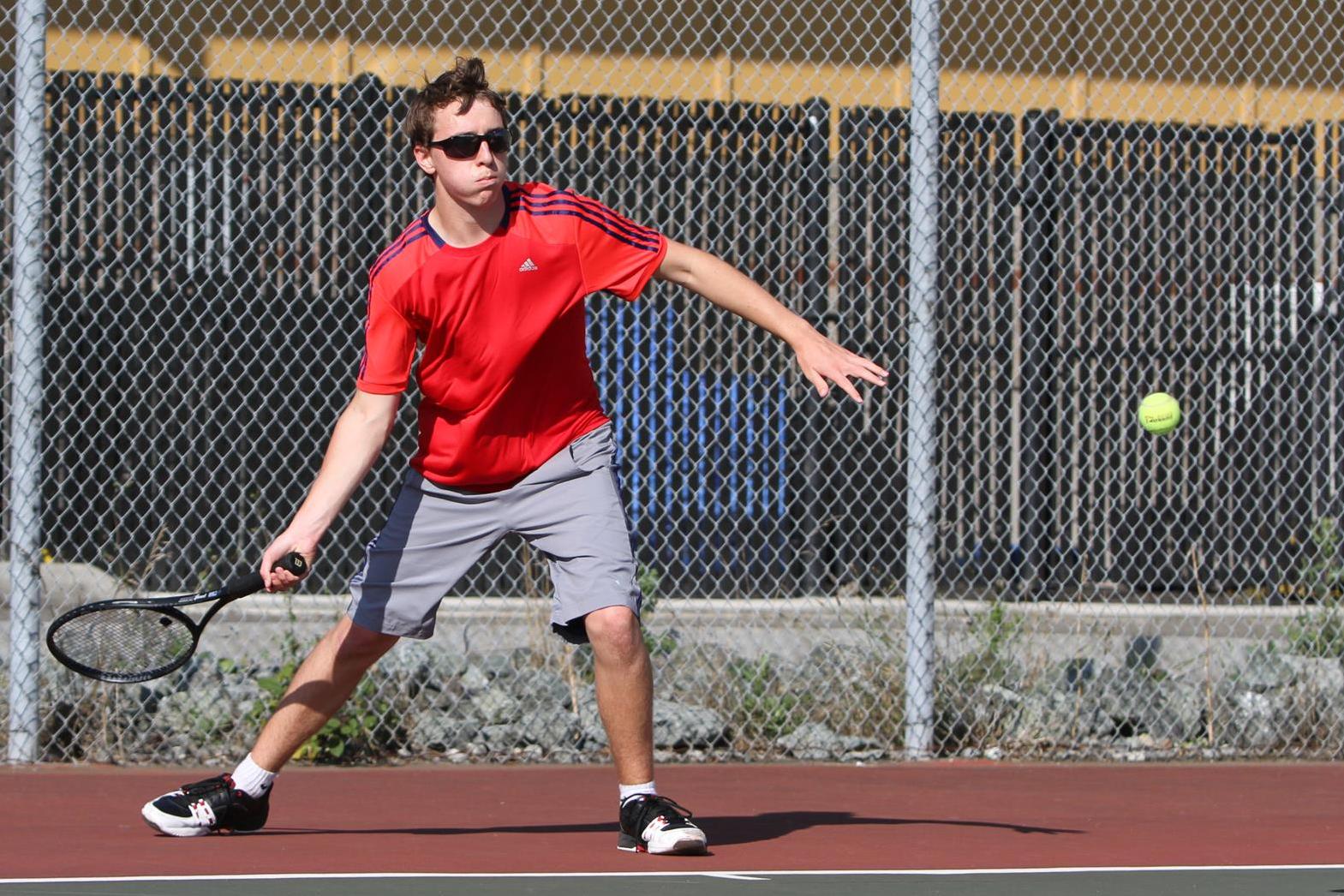
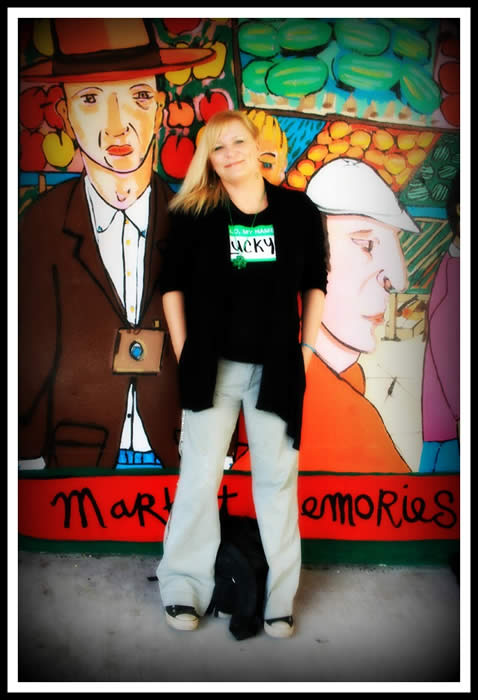
William Nelson rose to success while playing on multiple CHS tennis courts. (Photo by JohnsPhotos.net)

The mission is complete … for now.

Ken Stange recently wrapped an 18-year run as Coupeville High School tennis coach, leading the Wolves through two seasons most years.

As he marinates in his “retirement” down at Bailey’s Corner Store, he’s sharing memories, deep thoughts, and (maybe) clues to where the bodies are buried.

A nine-part odyssey inside the mind of the man, the myth, the always-entertaining net guru:


We played the final match at the CHS tennis facility, right next to the school, this spring.

When the current school building was constructed, it was built around the already existing tennis facility.

Maybe they didn’t fit a new tennis facility into the bond that paid for the new school and gym remodel.

I loved that our courts were a prominent feature of the main school building. It was a great venue for a match, with some good viewing spots.

High school tennis matches don’t usually draw a large crowd, but there were a few years when our top singles player or doubles team were state medal contenders and, in those years, we drew large crowds for our matches.

Anyhow, I don’t know what to think about the district finally building a new tennis facility for what would have been my nineteenth year, had I stayed on as coach.

I do know that when it opens, I will certainly be one of the first people to play on the new courts.
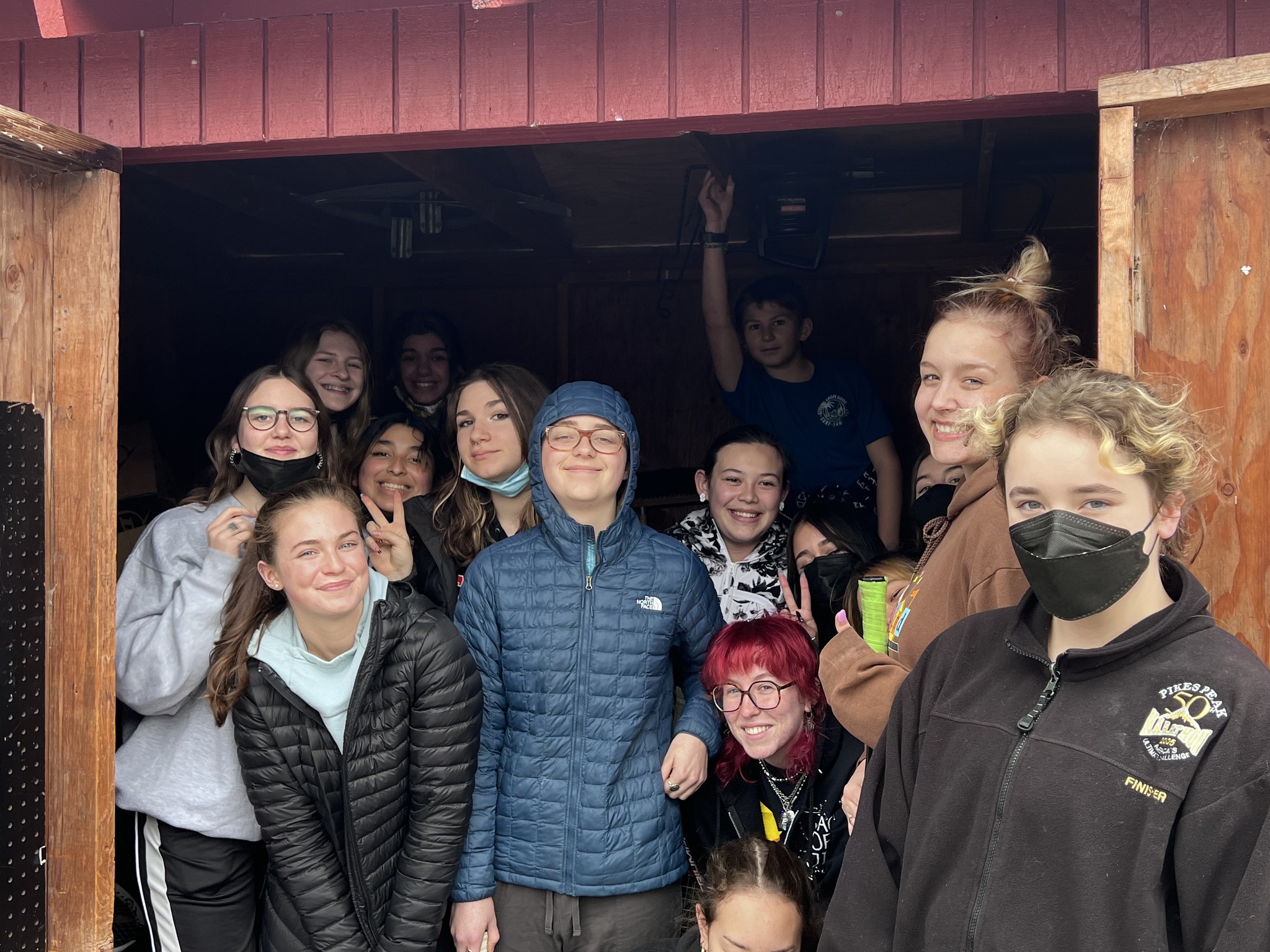
“Put us in, coach!” Coupeville tennis players avoid the weather by hanging out in a courtside shed. (Photo courtesy Ken Stange)

Those four courts hold many of my tennis memories.

Most are related to the players I coached, but many are related to my own tennis escapades, apart from the team.

If those courts could talk, here is what I think they’d say about my time there.

Court 4 would have some wild memories.

Despite being the least accessible, least popular, and most dangerous court to play on, it would say that the ride was good.

It would tell you how McKenzie Bailey and Jazmine Franklin owned that court for two years, putting up a 28-4 regular season record in the second doubles spot.

It would tell you how it bore witness to and helped shape the rise of Joey Lippo and William Nelson, #2 doubles duo who dethroned their #1 doubles teammates at the district tournament during their junior year.

It would tell you that even though it was always the last court chosen when recreational players showed up, it was always the home for a #2 doubles match, and that a team without a solid #2 doubles team won’t win many matches.

Being the court with a complex about being the least popular, it would be the first of the courts to tell you that it saw its fair share of wild #3 doubles matches.

Even though the other three courts could say the same thing because #3 doubles was the fifth match and never had a pre-assigned court.

It would tell you about how some of the greats from that time began their high school tennis careers at #3 doubles, and that those contests were usually the deciding matches.

It would tell you about how it had a special ability to bring out the most fun in players, maybe because it was the furthest away.

It would tell you that I fought for a giant depression behind the baseline to be fixed, and how after repeated requests and no action, it told me to send a formal maintenance request that included the words “insurance liability” in the description.

It would say, “See, Ken. You didn’t like me, and you rarely played on me, but look at those memories. You loved me all along!”

It would most certainly be correct.

Court 2 would share its own set of memories.

It would say that of all the courts, it was home to both some of the most exciting moments as well as some of the dullest moments in CHS tennis history.

It would tell you that it was the most uniquely positioned of the four courts, with the school building running behind the baseline and then about three fourths of the way up to the net.

It would boast of its asymmetrical background.

It would tell you how Chase Bates was the first player to figure out how to use the strange wind current as an advantage.

How he discovered a way to hit a ball that looked like it was going wide, only to be pushed back into the court by the wind that whipped along the interior corner of the building.

It would tell you how it was home to some of the most exciting #2 singles matches throughout the years, and how many of the singles players that occupied it used it as a steppingstone to the #1 singles court.

It would repeatedly tell you about the time Ben Hayes played a district match, in front of nearly 100 classmates who cheered him on, turning a typically quiet tennis match into something raucous.

Something more like a nighttime match at the US Open.

It would tell you about the time that Micky LeVine hit me in the windpipe with a wicked forehand, and how I couldn’t breathe for a minute.

It would tell you how all the players had looks of horror on their faces, except for Haleigh Deasy, who was uncontrollably laughing.

Wolf netters (l to r) Micky LeVine, Jacki Ginnings, Wynter Thorne, and Haleigh Deasy were part of an entertaining crew. (Photo by JohnsPhotos.net)

It would tell you about the dull stuff, too … the #2 singles matches that were played at such a slow pace that they were often compared to watching paint dry on growing grass.

However, it would also tell you that many of those matches were carefully played and won, and that those individual wins contributed to team wins.

It would tell you that I played my own tennis on that court and that I absolutely loved the asymmetry, extra shadows, and uniqueness.

It would tell you about some hard-fought matches filled with ups, downs, and passion.

It would tell you about how it was the court I played my first competitive tennis after breaking my back, and how I cried, both from the pain of recovery and from the overwhelming emotions that came with knowing that I was able to play again.

It would admit that Court 1 was where I relearned how to hit every single tennis shot because I’d lost so much range of motion.

It would tell you that Avalon Renninger and Tia Wurzrainer were there, hitting the balls to me, as I slowly rehabbed while on court.

It would tell you about how patient and kind they were to me that year … how they completely took the reins for me when I was barely able to walk.

It would tell you how even though I spoke highly of it, I was truly in love with Court 1.


TOMORROW: Court 1 and the final goodbye.

Read Full Post »

Allie Hanigan, queen of the hardcourt. (Photo by JohnsPhotos.net)

The mission is complete … for now.

Ken Stange recently wrapped an 18-year run as Coupeville High School tennis coach, leading the Wolves through two seasons most years.

As he marinates in his “retirement” down at Bailey’s Corner Store, he’s sharing memories, deep thoughts, and (maybe) clues to where the bodies are buried.

A nine-part odyssey inside the mind of the man, the myth, the always-entertaining net guru:


We played many match formats over the years.

For my all-time teams, I will use the largest format we played: three singles players and four doubles teams.

Some players appear twice because they dominated both the singles and doubles courts.

There are players on the bench, too.

Sebastian Davis plays chess against rival netters playing checkers. (Photo by JohnsPhotos.net)


Boys:

#1 Singles: Aaron Curtin

#2 Singles: Ben Hayes

#3 Singles: Drake Borden

#1 Doubles: Aaron Curtin/Ben Etzell

#2 Doubles: Joey Lippo/ Will Nelson

#3 Doubles: Jordan Lamb/Nathan Lamb


Singles Bench:

Connor Tasoff
Sebastian Davis


Doubles Bench:

John McLarin/Joseph Wedekind
Mason Grove/James Wood


Jacki Ginnings (left) and Valen Trujillo, (incredibly polite) tennis assassins. (Photo courtesy Ken Stange)


Girls:

#1 Singles: Julia Sierra Castaño

#2 Singles: Helen Strelow

#3 Singles: Valen (Trujillo) Printz

#1 Doubles: Payton Aparicio/Sage Renninger

#2 Doubles: Hannah (Merrell) Bush/Megan (Monroe) Mindemann

#3 Doubles: Avalon Renninger/Tia Wurzrainer


Singles Bench:

Amanda d’Almeida
Emily Burchfield
Allie Hanigan
Jacki (Ginnings) McCormick


Doubles Bench:

Amanda d’Almeida/Jessica (Riddle) McIvor-Garman
McKenzie Bailey/Jazmine Franklin

Read Full Post »

Jazmine Franklin (front) and McKenzie Bailey blossomed as tennis players under the guidance of Ken Stange. (Photo by JohnsPhotos.net)

The mission is complete … for now.

Ken Stange recently wrapped an 18-year run as Coupeville High School tennis coach, leading the Wolves through two seasons most years.

As he marinates in his “retirement” down at Bailey’s Corner Store, he’s sharing memories, deep thoughts, and (maybe) clues to where the bodies are buried.

A nine-part odyssey inside the mind of the man, the myth, the always-entertaining net guru:


My first girls season, in the spring of 2006, was much like my fall season with the boys, in that the players were short on experience.

Eighteen kids showed up that spring, which was double that of the boys in the fall.

Most of them had never played a competitive tennis point in their lives.

We lost so many matches that year.

They were excited, though. Much fun was had at practice, and several players were working diligently on their games.

Looking at the team photo from that season, more than half the kids were 10th and 11th graders from the classes of 2008-2009 and they ended up having long and productive high school tennis careers.

Those kids set a standard that future players would follow and eventually exceed.

They took ownership of the team and held each other accountable.

There were two players who stood out … players who decided to make tennis their sport.

They made tennis cool.

They worked hard, won bunches of matches, and even went to state during their junior season.

Hannah (Merrell) Bush and Megan (Monroe) Mindemann showed up that first year and they loved it. They put 100% of their athletic focus on tennis.

They recruited friends and got younger athletes to join.

They were the mothers of my incarnation of the CHS tennis program.

They set the example that other players would follow and when future leaders emerged, Hannah and Megan took them under their wings, and the process continued for a very long time, with each leadership group passing the torch to the next group.

Big wins and tasty ice cream — the Wolf way. (Photo courtesy Ken Stange)

The line of leadership lineage of the CHS girls’ program is long.

Hannah and Megan, along with Ashley Sanders, passed the torch along to Jordan Akins and Jessica Blanchette, who passed it along to Amanda d’Almeida.

There were more: Jacki Ginnings, Wynter Thorne, McKenzie Bailey and Jazmine Franklin, Valen (Trujillo) Printz, Sage Renninger and Payton Aparicio, Avalon Renninger and Tia Wurzrainer, Genna Wright, Abby Mulholland, Noelle Daigneault, and finally, Helen Strelow.

I’m sure that with both the boys and the girls, I’ve missed a few.

The net guru works on his tan while his crew prepares to kick some fanny. (Photo courtesy Ken Stange)

It seemed that for a long time, the level of play increased from year to year.

That made coaching the girls’ team extra fun.

With the girls, there was a season within the season, in that the kids were always competing for spots in the lineup and looking to get better than the person or pair in front of them.

That kind of mentality gave us lots of wins and league titles.

Despite the in-team competition, the girls also genuinely cared about how everyone else did.

They always remembered the team component that existed within individual sports.

Kids were willing to play a different spot in the lineup to better ensure a team win.

With that kind of attitude, I’m not surprised by the numbers the girls put up during my time as coach.

Read Full Post »

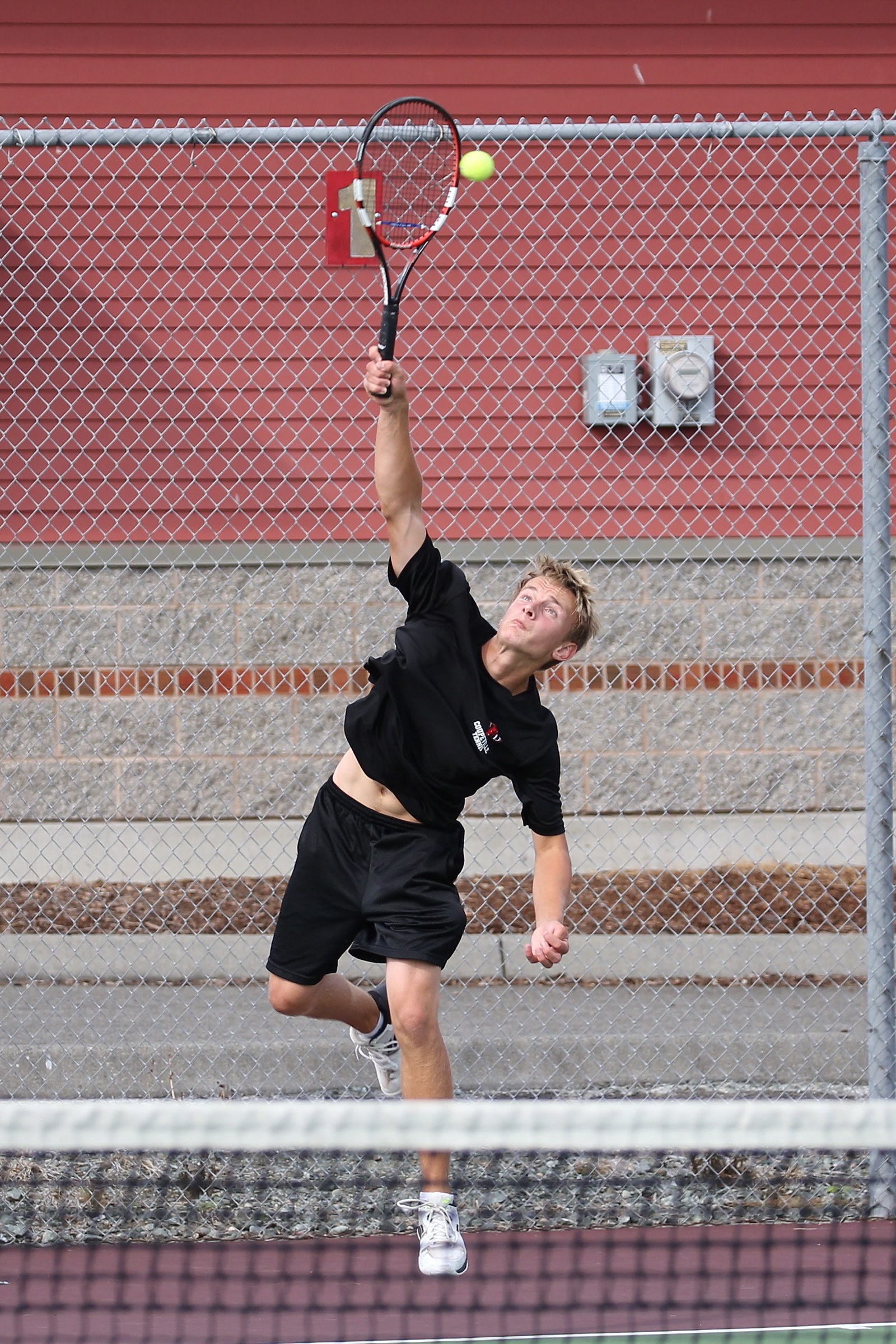
Drake Borden, perhaps the last great Wolf boy’s netter, unleashes a serve. (Photo by JohnsPhotos.net)

The mission is complete … for now.

Ken Stange recently wrapped an 18-year run as Coupeville High School tennis coach, leading the Wolves through two seasons most years.

As he marinates in his “retirement” down at Bailey’s Corner Store, he’s sharing memories, deep thoughts, and (maybe) clues to where the bodies are buried.

A nine-part odyssey inside the mind of the man, the myth, the always-entertaining net guru:


After my first year of teaching in Coupeville, Pastor Cliff Horr, tennis coach and one of my favorite doubles partners, decided that 10 years was enough coaching for him.

Perhaps the fact that his entire boys’ and girls’ varsity squads had graduated influenced his decision.

Anyhow, I showed up for practice in the fall of 2005 to see about nine boys ready to play tennis. It wasn’t quite what I had expected.

Talent was low and numbers were few.

Still, there was a young man named Aaron Gavin.

He wasn’t the best tennis player, but he was a great leader.

There were also a few young players who would be with me for all four years, and they were the first building blocks of the boys’ program.

That first fall was rough. We lost almost all our matches. There was much room for improvement.

There was one odd but teachable moment that season.

It was the day of my first match as tennis coach.

We were on the way to South Whidbey to take a beating from the Falcons, and I heard some nefarious sounds coming from the back of the bus.

I went to the back to investigate and saw a kid swallow and start chewing a sheet of paper.

As the bus pulled into the parking lot, I told the boy to spit out the paper and show me, or we’d turn the bus around and I’d resign from my coaching position.

Let’s just say that it was not a note anyone would want to read, and they were showing it to the car travelling behind the bus.

I told the nine boys to meet me at the track the next day and to wear good running shoes.

Collectively, the nine boys ran 15 miles that day, as the girls’ soccer team jeered them for their behavior.

I think I made my mark that day.

There was one young man, Jake Weaver, who had nothing to do with the nonsense of that day.

He did most of the running that day. It was the day he took the role as a leader.

Play improved and players held themselves accountable.

And that’s how it went. Kids took the lead.

Aaron Gavin graduated, and Jake took the reins of leadership.

Each season, new kids arrived … each season, the level of play improved.

Early lessons helped build success later. (Photo courtesy Ken Stange)

I was blessed in year two with the arrival of the class of 2010 and Connor Tasoff.

He brought friends: Jordan Lamb, Travis Curtin, and Garrett Knoll.

That was a core group of four that would eventually take 1st and 2nd in both singles and doubles in our league tournament.

I consider Connor Tasoff to be the father of the tennis program at CHS.

He was the first “tennis junkie” to join the team. He and his friends made tennis cool.

He was a leader.

If I could go back in time and change the tennis history of only one guy, I would have had Connor go to state.

Any success I had in my years of coaching the guys at CHS goes back to him.

He started something, and it rolled on and on, from 2006-2019, which was the last year of the CHS boys’ tennis program.

Connor and his crew set the example that would be followed by a very long list of singles players and doubles teams.

After Connor came Ben Hayes and Nathan Lamb.

After Ben and Nathan came Aaron Curtin.

After Aaron came Jakobi Baumann.

After Jakobi came Drake Borden.

Drake was the last of the greats. If Connor was the father of the program, Drake was the youngest son.

Much like Connor, Drake had true love for the game.

He played and watched, and he analyzed and worked on his game.

Of all the singles players I had, Drake played in the most difficult league. He went toe to toe with some of the best players in the state and he garnered their respect.

Had my spine been healthy enough to hit with him during his senior year, he would’ve beaten me easily.

After Drake came COVID, the move to the 2B classification with soccer in the fall, and the death of the boys’ tennis program.

There were doubles teams, too.

Not always was the top singles player at the top of the ladder.

Garrett Knoll and Travis Curtin.

Aaron Curtin and Ben Etzell.

Joseph Wedekind and John McClarin.

Joey Lippo and Will Nelson.

James Wood and Mason Grove.

These guys all ascended to become the top duo. They lived on Court #3, where the top doubles teams always played.

Whether the leadership came from a singles player or doubles team, the knowledge was always passed down to the next guys.

We always had fun in the fall.

Let the awards (and cupcakes) rain down. (Photo courtesy Ken Stange)

One of the best parts of the season was the end of season awards dinner thing that sports teams do.

We tried to have it away from the school as much as possible because we spent too much time at school already.

According to the kids, our dinner was the best of any team, because the families brought their best dishes.

I’m sure I wasn’t the only one who would eat light all day because I knew that we’d dine like kings at the awards dinner.

Anyone who was on the team while Garrett and Jason Knoll played probably still remembers the perfectly colored tennis ball cupcakes made by Peggy Knoll.

Read Full Post »

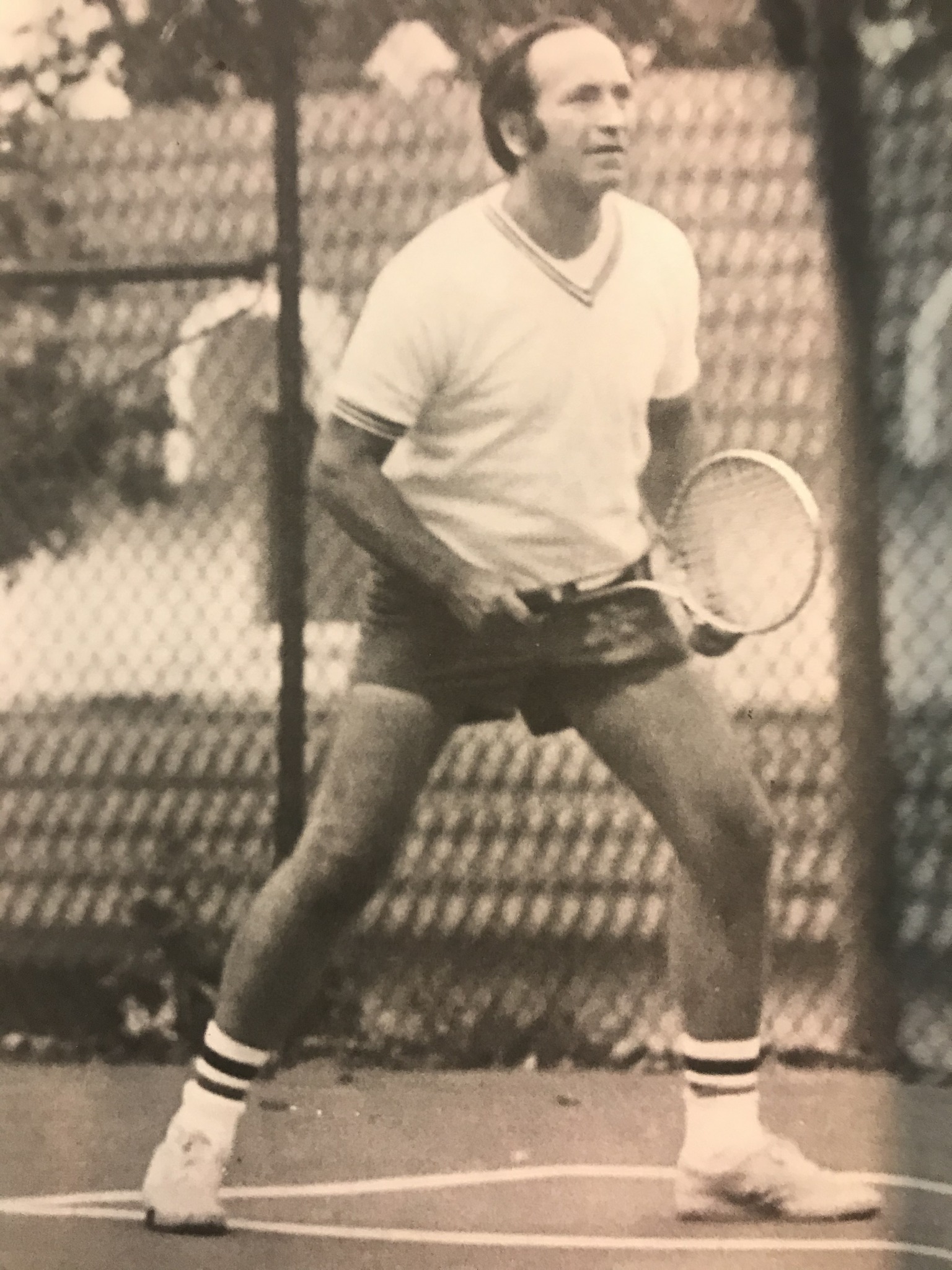
Ray Stange, master of the hardcourt. (Photos courtesy Ken Stange)

The mission is complete … for now.

Ken Stange recently wrapped an 18-year run as Coupeville High School tennis coach, leading the Wolves through two seasons most years.

As he marinates in his “retirement” down at Bailey’s Corner Store, he’s sharing memories, deep thoughts, and (maybe) clues to where the bodies are buried.

A nine-part odyssey inside the mind of the man, the myth, the always-entertaining net guru:


Some of the seeds of my coaching career were planted by my dad, Ray.

He gave me tennis.

Dad got me out on the court when I was about eight years old.

We loved sports. We were huge fans of all the Seattle teams, especially the Sonics and Seahawks.

I’ve got endless memories of trips to Seattle to see our teams play against some of the greats.

Tennis was the game we played, though.

He taught me and paid for some lessons.

He kept me flush with racquets, strings, and shoes.

I loved playing. I was average at other sports but in tennis, I learned how to wield my racquet well.

I wanted to get better.

When he was at work and unable to play with me, I’d hit against a wall, or I’d try to convince my friends to play with me.

Eventually, I was almost good enough to play with his crew, so he obliged and let me learn from the older men.

My game improved by leaps and bounds.

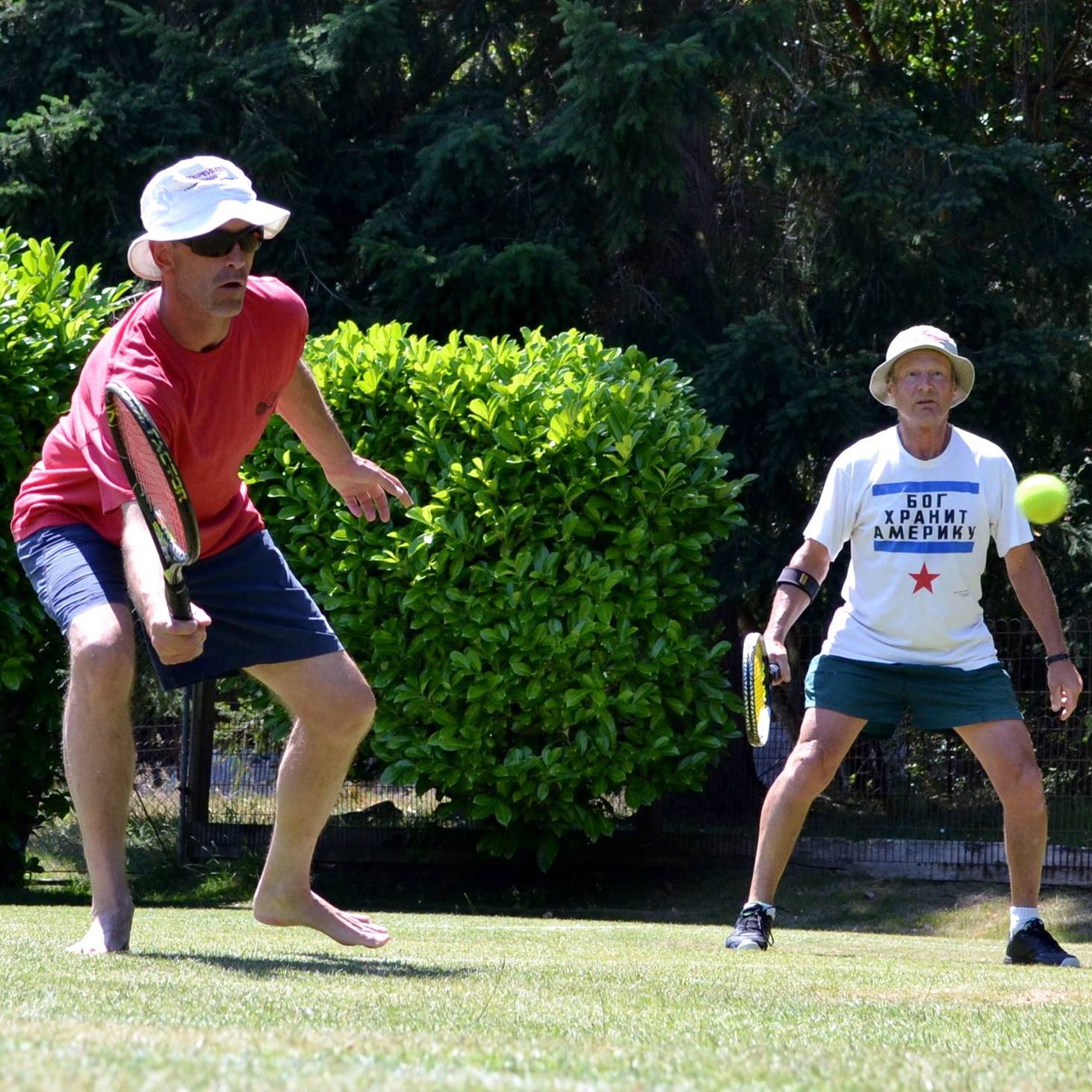
Ken Stange (left), always at home on the court.

In the spring of my ninth-grade year, I was excited to join the tennis team.

It had been a rough year.

My mom had passed just before Christmas, and I was full of depression and angst.

On the first day of the season, I walked from the junior high to the big bad high school (that school was grades 10-12) with excitement.

It was a welcome escape from what had been a hellish year so far.

Turns out, my depression and angst did not sit well with my tennis coach.

It didn’t take long for him to hate me, and he didn’t really disguise his feelings for me.

My tennis coach, who was ironically, the psychology teacher, came up with a nickname for me.

My new name was Fat. True story!

He was not my favorite person.

Luckily, I found a family in my teammates, who welcomed me with open arms, and with the assistant coach, who went to great lengths to help me process my mom’s death and all that depression and angst.

But that coach … he planted the other half of the seeds of my coaching career.

The ones that would help me focus on being kind and understanding; a coaching career that would allow players the chance to grow and the chance to be competitive.

Funny story: eventually, my coach could not deny me. In my senior year, my teammates voted me as captain.

He finally gave me the chance to play him at practice.

While I was up 4-1 in the first set, he stopped playing, grabbed his gear, and left practice early.

Years later, I would play Ben Hayes in practice.

He beat me. He was the first CHS kid to do so. I think I hugged him.

I owe a lot to Coach SoAndSo.

In my early years of coaching, when I often didn’t know how to proceed, I would ask myself how he would have done it. Then I did exactly the opposite.

Aside from doing the opposite of Coach SoAndSo, I often looked to my dad for advice related to tennis.

He was an excellent resource that possessed a wealth of information and experience.

My dad was the biggest CHS tennis supporter who never came to a match!

Forever the inspiration.

Every time we talked on the phone, Dad would listen to me give the details of matches … my players … the kids I felt could possibly make it to state.

He was my rock, and until he was 89, he was the official supplier of CHS practice tennis balls.

He collected the once used balls from the places he played and saved them for me.

Twice a year, I’d pick up several hundred tennis balls, many of which would end up being given to opposing teams, nursing homes (for walkers), and teachers whose classrooms had uncarpeted floors and metal chair legs.

Read Full Post »

« Newer Posts - Older Posts »