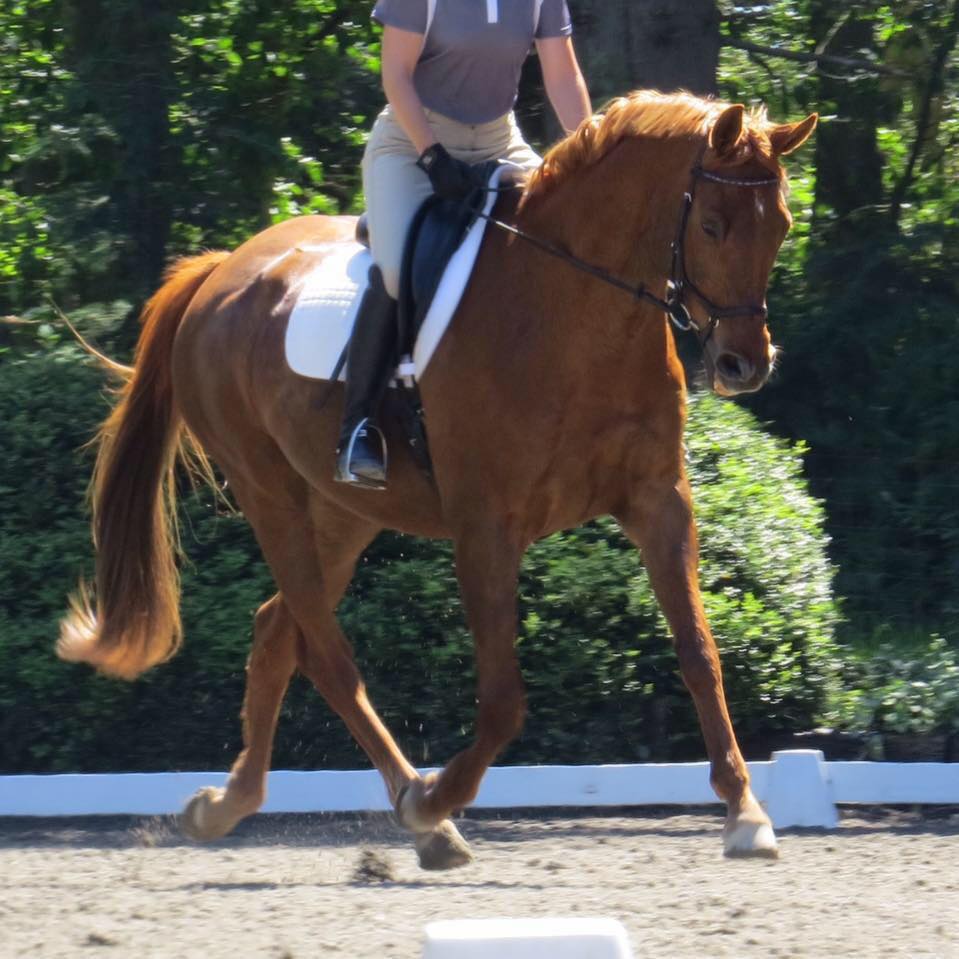
You need to focus on more than one area to see the full picture of Coupeville school athletics. (Photos by JohnsPhotos.net)
Coupeville, like a lot of school districts in Washington state, is in a financial crunch.
Current plans call for budget cuts of up to $1.66 million, in an effort to restore the general fund balance to where it’s supposed to be.
The first cuts, approved by the school board last week, include the secondary music program, STEM or art/music at the elementary school, and up to six certificated teaching positions, mostly through attrition.
Those decisions, by state law and contract requirements, had to be made in April.
The majority of cuts are still ahead of us, however, and are expected to be announced by late May.
From paraeducators to food service, every area in the district will be in play.
One knee jerk response, generally from those who haven’t actually looked at the numbers, is that sports somehow take a disproportionate amount of dollars.
With that in mind, I asked CHS/CMS Athletic Director Willie Smith to detail why those who might call for athletics to be hacked are misguided.
His reply:
As is often the case when a school district becomes embroiled in budget cuts, athletics is generally seen as a place to cut costs.
The visual from most is that costs incurred from athletic teams is a major part of the overall budget or as has been recently stated, an emphasis is placed on saving athletic programs and ensuring they have the funding to continue.
First, I’d like to show the impact our athletic programs have had on our school and community:
Athletics and Academics:
All high school teams have a cumulative grade point average of 3.0 or higher, with winter cheer 6th best in state and boys’ cross country 5th in state.
Participation numbers compared to overall school enrollment:
Fall middle school (cross country/volleyball): 61/239 — 25% total population participated.
Fall high school (cross country, volleyball, football, soccer, cheer): 119/266 — 45% total population participated.
Winter middle school (basketball): 70/239 — 29% total population participated.
Winter high school (basketball, cheer, wrestling/swim co-ops): 71/266 — 27% total population participated.
Spring middle school (track and field): 77/239 — 32% total population participated.
Spring high school (track and field, baseball, softball, girls’ tennis): 110/266 — 41% total population participated.
Athletes doing service in our community:
Volunteer during school recesses and lunch at elementary school.
Volunteer to plan, organize, and run an introduction to Sports Day for grades 3-5.
Volunteer as officials/clock management during youth basketball games December-February, each Saturday.
Volunteer to help run volleyball clinics for elementary students.
Volunteer to help run junior cheer program for elementary students.
Run an annual Toy Drive for Coupeville Help House during December.
Support and run fundraiser for cancer awareness throughout the year.
Help with Lion’s Club garage sale.
There are two sources of revenue in schools which I work with directly.
These are ASB funds, which are funds generated by students/parents and can only be used by students, and district generated funds, which come from the state, levies, grants, etc.
Here is the breakdown of how each of those contribute to funding our athletic programs.
ASB Generated Funds
Pay to Participate Funds (revenue for individual programs) — students are required to pay a fee in order to participate in every sport.
This money goes directly to that specific sport ($75 for high school, $50 for middle school).
ASB card sales (revenue for general athletics account only) — each student is also required to pay an ASB fee in order to participate in athletics.
It is a yearly, one-time fee and covers participation in all sports the student chooses whether it’s one or multiple.
General athletics receives 60% of each card sale ($35 HS, $20 MS), which is used to cover general costs incurred throughout the year.
Required costs for school:
WIAA (state middle and high school governing body) membership.
District 1 membership.
League membership — Cascade League for middle school, Northwest 2B/1B League for high school.
Final Forms.
NFHS (streaming service).
Sports photo contract.
**These equal to about $7,500-$8,000 per year.
These fees can be waived per House Bill 1660 which stipulates any student who qualifies at the free/reduced level gets all fees waived.
This reduces our revenue by about 20-30% yearly.
ASB fundraisers (revenue created by each program, run by our coaching staffs and student-athletes):
Each high school sport is required to run a fundraiser(s) in order to pay for the following:
Uniforms (on a 4-year rotation scale).
Basic equipment required for each sport.
Overnight stays during the regular season — this includes paying for meals, hotels, costs incurred including the coaches, athletes and bus driver.
District tournament costs including overnight stay costs if required.
Coupeville Booster Club:
Provides between $600-$3,000 per high school team and $800 per middle school team to be used to purchase items not covered above.
Coaches must request and have approval in order to receive the funds; it is not automatically distributed to each program.
District funds cover:
Transportation costs: excluding any regular/district tournament overnight costs as explained above.
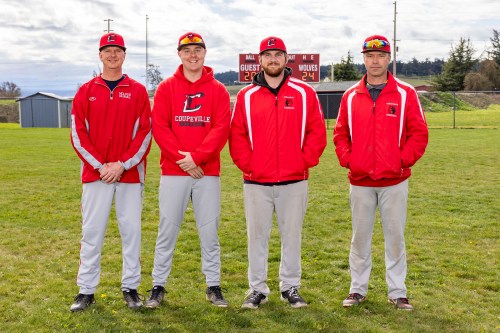
Wolf coaches, whether paid or volunteers, provide quality leadership.
Coaches’ stipends (currently 52 total coaches with 29 paid and 23 volunteers).
HS coaches’ salary range: $3,100-$5,500.
MS coaches’ salary range: $2,000-$3,100.
Athletic Director stipend: $8,200-$10,000
Under the new WIAA coaching requirements, all coaches, paid or volunteer are considered the same in regard to:
Required 1st Aid/CPR training (currently district paid).
Annual WIAA clinics (free).
Continuing coaching education (currently district paid, registration fee(s) only and currently on hold for remainder of this year).
Event worker stipends — game managers, ticket takers, scoreboard operators, bookkeepers (volleyball and basketball), announcer.
High school game manager: $13 per hour.
Middle school game manager: $12 per hour.
Ticket taker, clock operator, scoreboard operator, bookkeeper: $12 per hour.
Game announcer: $16 per hour.
None of these employees receive any benefit outside of the stipend.
Football helmet reconditioning:
The state of Washington and the WIAA require football helmets to undergo reconditioning each year based on the age of the helmet (on average $2,500-$3,000).
Once the helmet has reached a certain age it is thrown out and new helmets are purchased through the football ASB account (currently $400 on average per helmet).
State contests:
Travel costs, overnight stay (bus driver, paid coaching staff, hotel rooms, meal money for athletes/paid coaches).
If you assume that the average stipend of our high school staff is $4,500 per coach and the average salary of our middle school staff is $3,100 and you cut the entire amount it would come to $116,500.
If you add in the athletic director stipend at the top end of the scale the district would save a total of $126,500.
While I understand the optics of cutting athletics is a good idea, it has no fiscal sense when you compare the impact of the totality of the athletic program on the overall district budget (less than 1-2% of the overall budget) with what our athletic programs provide in our schools, community, and, most importantly, to our students.

Read Full Post »
 Cut season is coming. Possibly.










































 Coupeville Sports